Fate, chance, and premonition
Crime and PunishmentFate, chance, and premonition describes the tension between ordinary causes and Raskolnikov’s conviction that certain coincidences arrive with the force of a design. A needless detour to the Hay Market reveals when Alyona Ivanovna will be alone, while an earlier chance conversation has already made her and the idea of killing her occupy his thoughts. The novel presents these openings as explainable accidents, but shows how Raskolnikov retrospectively experiences them as signs that his course has been fixed.
Chance Recalled as Destiny
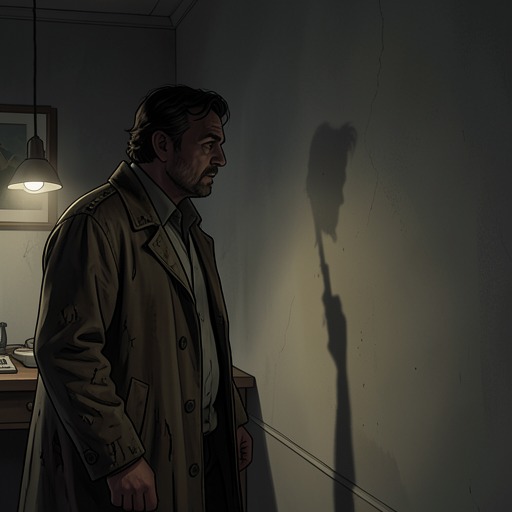
Later, Raskolnikov returns in memory to the days surrounding the decisive meeting in the Hay Market. He is struck by the route he took: tired and worn out, he could have gone home directly, yet he turned through a place where he had no practical reason to be. He knows that he often wandered through streets without noticing them, and that this particular detour was not especially long. Those ordinary circumstances make the meeting harder, not easier, for him to explain. He wonders why it occurred at precisely the hour when his state of mind and situation made it capable of exerting a grave influence on his future.
His later recollection gives the chance encounter the shape of a turning point. The narrator reports that he becomes superstitiously impressed by it and cannot settle whether to regard it as mere accident or as something that seemed to have been waiting for him. The language of predestination belongs to Raskolnikov’s later interpretation, not to proof that a supernatural force has intervened. The distinction matters: the events remain commonplace in themselves, while their timing acquires an almost unbearable significance for the person who remembers them.
Coincidences Before the Market Meeting
The meeting is preceded by another coincidence that has already linked Alyona Ivanovna to Raskolnikov’s developing idea. Some six weeks earlier, he had recalled an address given to him by a student acquaintance, Pokorev, in case he ever needed to pawn something. He took a small gold ring, a parting gift from his sister, to the pawnbroker and received two roubles. He felt an immediate, intense repulsion toward her, then went to a poor tavern, ordered tea, and sat absorbed in a strange idea that was taking shape in his mind.
At a neighboring table, an unfamiliar student spoke to an officer about Alyona Ivanovna. Raskolnikov had just been to her, so hearing her name at once seemed extraordinary to him. The student described her as wealthy but predatory in her dealings: she accepted pledges worth little compared with their value and charged steep monthly interest, while forfeiting a pledge after even a short delay. He also described her younger sister, Lizaveta Ivanovna, as abused and kept in bondage by Alyona. What Raskolnikov overhears is ordinary tavern talk, but its subject coincides with the thoughts he has just carried away from the pawnbroker’s rooms.
The conversation develops into a discussion of whether Alyona’s life is worth preserving, and of the possibility of killing her. Raskolnikov is violently agitated by hearing ideas that resemble those already forming in his own mind. In his later account, the coincidence seems to have supplied a guiding hint; at the time, it is the disturbing nearness of another person’s talk to his private thought that gives it force. The scene does not establish that the student’s words cause Raskolnikov’s plan. It shows instead how an idea he has not yet resolved can seem confirmed when it appears in the world outside him.
The Hay Market as an Opening
When Raskolnikov returns to the Hay Market, the late hour gives the scene its ordinary, public setting. At about nine o’clock, traders are closing stalls, packing their wares, and heading home. The market and its neighboring alleys are places where he can wander without drawing the contemptuous attention his rags attract elsewhere. At a corner, a huckster and his wife are speaking with Lizaveta, who has come with a bundle and is listening to them earnestly.
Raskolnikov already knows who she is: the unmarried, roughly thirty-five-year-old sister of the pawnbroker he has visited. Tall, clumsy, timid, and submissive, Lizaveta lives in fear of Alyona, who makes her work day and night and beats her. The huckster and his wife invite Lizaveta to come the next day. Their reason, learned by Raskolnikov only later, is practical: a poor family is selling household goods and clothing, and Lizaveta regularly works as a dealer in such things, honestly fixing a fair price. The details that make this an unremarkable arrangement also explain why Lizaveta has been asked to go out.
Raskolnikov passes close enough to hear that she will be away from home at seven the following evening. Alyona, her sister’s only companion, will therefore be alone. The information comes to him without inquiry, pursuit, or dangerous investigation, and with a precision he could hardly have secured by deliberate planning. His first amazement gives way to horror. Near his lodging, he feels that he has lost freedom of thought and will, as if the decision has already been made for him. In practical terms, the coincidence creates an unusually certain opportunity; in his immediate experience, it seems to close off the possibility of choosing otherwise.
Meaning and Limits of the Premonition
The sequence makes fate appear through the arrangement of otherwise explicable events: an address once given by an acquaintance, a pawning visit, a conversation overheard over tea, an unnecessary walk, and a routine invitation to Lizaveta. Each has an ordinary cause. The dramatic pressure comes from their convergence around Raskolnikov’s concealed intention, so that chance can be read either as a chain of accidents or as a pattern that seems to anticipate what he is preparing to do.
Raskolnikov’s retrospective superstition does not resolve that ambiguity. He repeatedly asks why the meeting happened at that precise moment, and experiences it as though it had lain in wait for him, yet the narrator also emphasizes that the circumstances were not exceptional in themselves. The concept therefore marks both the plot’s mechanism and a feature of Raskolnikov’s perception: an opportunity appears without being summoned, then acquires the emotional weight of an instruction. The narrative shows how the sense of inevitability grows from coincidence, while leaving the coincidence itself within the bounds of ordinary life.